RREF vs Gaussian Elimination: Which to Use & When
Most linear algebra students hit a wall at some point — not because they can’t do the math, but because nobody told them when to use which method. You’ve got RREF, Gaussian elimination, and LU decomposition sitting in your toolkit, and they all seem to do the same thing. They don’t.
Each method exists for a specific job. Using the wrong one wastes time on exams and produces errors in computational problems. Here’s the clear breakdown.
What These Three Methods Actually Do
Before comparing speed or exam context, it helps to understand what each method is fundamentally solving.
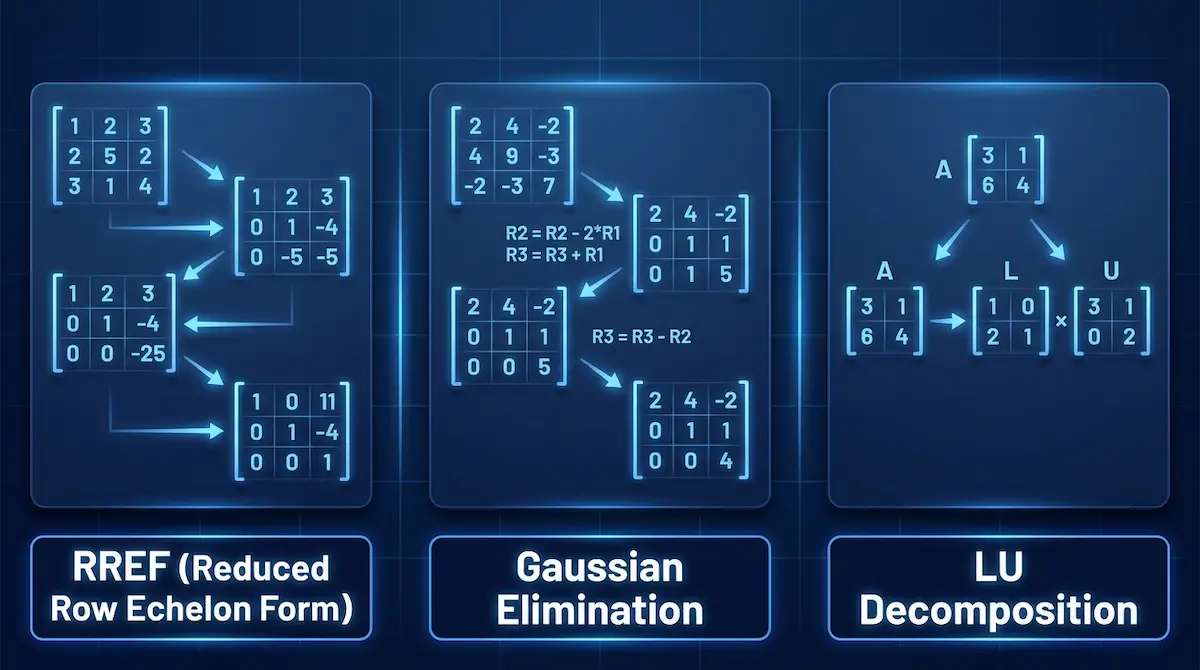
- Gaussian elimination transforms a matrix into row echelon form (REF) — a staircase pattern where everything below each pivot is zero. From there, you use back-substitution to find the solution. It’s a forward-only process.
- RREF (Reduced Row Echelon Form) takes Gaussian elimination further. It uses the Gauss-Jordan elimination algorithm to zero out entries above each pivot too, not just below. The result is a fully reduced matrix where solutions can be read directly — no back-substitution needed.
- LU decomposition factors a matrix A into two triangular matrices: a lower triangular matrix L and an upper triangular matrix U, such that A = LU. It’s not really about solving one system — it’s about solving many systems with the same coefficient matrix efficiently.
These are distinct tools, not interchangeable shortcuts.
Speed Comparison: Which Method Is Actually Faster?
Small Systems (2×2, 3×3)
For hand calculations on 2×2 or 3×3 systems, Gaussian elimination with back-substitution is fastest. RREF takes extra steps to zero above the pivot, which adds unnecessary row operations when you’re working by hand. LU decomposition has overhead that doesn’t pay off at this scale.
Winner: Gaussian elimination
Single System, Medium Size (4×4 to 6×6)
RREF becomes useful here, especially for systems with free variables or when checking for linear independence. The fully reduced output is unambiguous — you don’t have to track which variables are free or interpret partial results.
Gaussian elimination is still slightly fewer operations, but RREF’s clarity often saves time overall, especially when interpreting results matters more than raw computation speed.
Winner: RREF (for clarity) / Gaussian elimination (for raw speed)
Same Coefficient Matrix, Multiple Right-Hand Sides
This is where LU decomposition dominates. If you’re solving Ax = b₁, Ax = b₂, Ax = b₃ with the same matrix A but different vectors b, factoring A into LU once and solving each system with forward and back substitution is far more efficient than running Gaussian elimination from scratch each time.
In numerical computing, LU decomposition (with partial pivoting for numerical stability) is the standard method used in software like MATLAB, NumPy, and SciPy when calling solve().
Winner: LU decomposition — not even close
Very Large Systems
For sparse matrices in engineering and scientific computing, neither Gaussian elimination nor RREF is practical. Iterative methods take over. But when direct methods are used, LU decomposition with pivoting is the baseline.
Which Method Do Exams Actually Expect?
This depends heavily on the course and problem type.
Undergraduate Linear Algebra Exams
Most undergraduate courses expect RREF as the default method. It’s taught as the standard procedure for:
- Solving systems of linear equations
- Finding the null space (kernel) of a matrix
- Determining rank and nullity
- Checking linear independence of vectors
- Computing the column space and row space
If an exam question says “solve the system” without specifying a method, RREF is the safe, expected answer.
Numerical Methods and Applied Math Courses
These courses typically expect Gaussian elimination with back-substitution, and often ask students to identify pivot elements, count row swaps, or compute the determinant as a byproduct of elimination. LU decomposition appears here as well, often paired with questions about condition number, numerical stability, and pivot strategies like partial or complete pivoting.
Engineering and Physics Courses
Expect Gaussian elimination or LU decomposition depending on whether the problem involves a one-time system or repeated solves. Matrix inversion using RREF (augmenting A with the identity matrix) also appears frequently in engineering linear algebra.
Computational and Programming Assignments
In code, LU decomposition is almost always preferred. It’s what libraries implement under the hood. Writing Gaussian elimination from scratch in Python or MATLAB for a large system is an academic exercise, not a practical approach.
Read also Balance Chemical Equations Using RREF: 3 Examples!
A Practical Decision Framework
Use this when choosing:
| Situation | Best Method |
|---|---|
| Hand-solving a 2×3 or 3×4 system | Gaussian elimination |
| Finding free variables, null space, rank | RREF |
| Checking if vectors are linearly independent | RREF |
| Solving Ax = b multiple times, same A | LU decomposition |
| Programming a solver in Python/MATLAB | LU decomposition |
| Undergraduate exam, no method specified | RREF |
| Numerical methods exam or engineering problem | Gaussian elimination or LU |
| Computing matrix inverse by hand | RREF (augmented with identity) |
The One Thing Most Students Get Wrong
They treat RREF as “more work” and try to stop at row echelon form to save time. On exams where free variables are involved, stopping at REF and doing sloppy back-substitution is where errors compound. RREF forces clarity — you can see exactly which columns are pivot columns and which correspond to free variables. That clarity is worth the extra row operations.
On the other hand, using RREF for everything in a numerical computing context is a mistake. RREF is not numerically stable for large matrices because it amplifies rounding errors. LU decomposition with partial pivoting handles this correctly.
Bottom Line
RREF is your go-to for most linear algebra coursework. Gaussian elimination is faster for simple, one-off hand calculations. LU decomposition is the right tool when efficiency and repeated computation matter.
Knowing which method fits the context isn’t just test strategy — it’s how working mathematicians, engineers, and data scientists actually think about matrix problems.