Balance Chemical Equations Using RREF: 3 Examples
Balancing a chemical equation by inspection works fine for simple reactions. Once you hit a redox half-cell, a long-chain organic combustion, or anything with five or more species, guessing coefficients turns into a slow, error-prone slog. There is a faster way: set up the conservation rules as a homogeneous linear system, reduce the matrix to RREF, and read the coefficients straight out of the null space.
This guide shows the full method on three reactions chemistry students get stuck on most often.
Why RREF works for balancing equations
A balanced chemical equation is a statement of two things: every element is conserved on both sides, and total charge is conserved. Both rules are linear in the unknown coefficients. That means you can write them as a matrix equation Ax = 0, where each row is one conservation law and each column is one chemical species.
The solution lives in the null space of A. Reducing A to reduced row echelon form exposes the free variables and the pivots, so the smallest positive integer solution drops out without any trial and error. The method is mass-action neutral, so it handles redox, combustion, hydrocarbons, and complex ions identically.
If you want to follow along, the RREF Calculator on this site runs the row reduction in exact fractions, which matters here — decimal rounding can wreck integer coefficients.
How to set up the augmented matrix
The recipe is the same every time:
- Assign a variable (a, b, c, …) to each species.
- Write one equation per element: atoms on the left minus atoms on the right equals zero.
- If ions are present, add one equation for total charge.
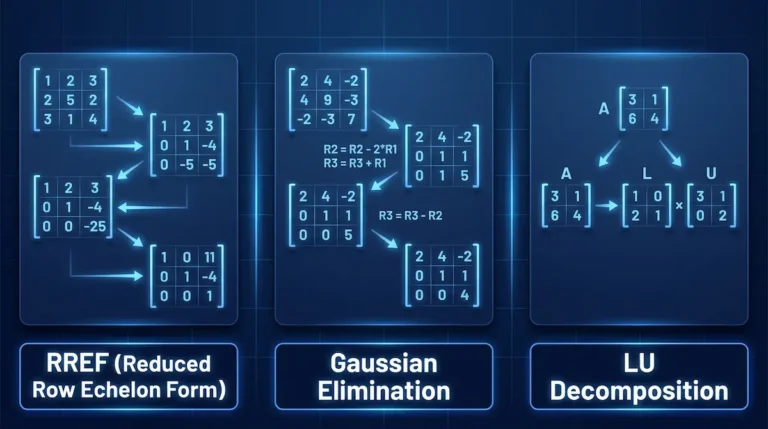
- Put the coefficients into a matrix. Reduce to RREF.
- The null space vector gives the ratios. Scale to the smallest positive integers.
You do not need an augmented constants column for balancing — the right-hand side is zero — so the coefficient matrix alone is enough.
Example 1: Combustion of propane (easy)
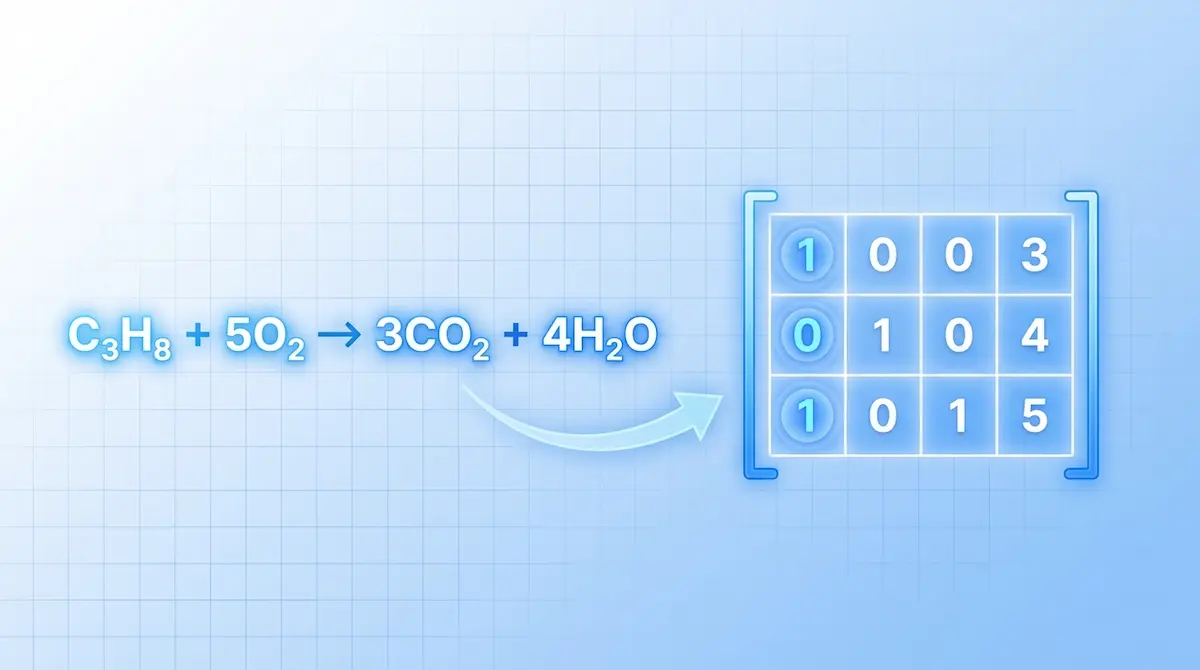
Reaction: a C₃H₈ + b O₂ → c CO₂ + d H₂O
Conservation laws:
- Carbon: 3a − c = 0
- Hydrogen: 8a − 2d = 0
- Oxygen: 2b − 2c − d = 0
Matrix form:
[ 3  0  -1   0 ]
[ 8  0   0  -2 ]
[ 0  2  -2  -1 ]
After row reduction the RREF is:
[ 1  0  0  -1/4 ]
[ 0  1  0  -5/4 ]
[ 0  0  1  -3/4 ]
Setting the free variable d = 4 to clear denominators gives a = 1, b = 5, c = 3, d = 4.
Balanced equation: C₃H₈ + 5 O₂ → 3 CO₂ + 4 H₂O
Why the fractions matter
If your calculator displays decimals, you will see 0.25, 1.25, 0.75 — same answer, harder to scale. Switch the display to fractions before you read the result.
Example 2: Permanganate–oxalate redox in acidic solution
This one is a textbook nightmare to balance by half-reactions. The matrix method finishes it in one pass.
Reaction: a MnO₄⁻ + b C₂O₄²⁻ + c H⁺ → d Mn²⁺ + e CO₂ + f H₂O
Five conservation laws (four elements plus charge):
- Mn: a − d = 0
- O: 4a + 4b − 2e − f = 0
- C: 2b − e = 0
- H: c − 2f = 0
- Charge: −a − 2b + c − 2d = 0
Reducing the 5×6 coefficient matrix yields a null space vector with f as the free variable. Scaling to the smallest integers:
a = 2, b = 5, c = 16, d = 2, e = 10, f = 8
Balanced equation: 2 MnO₄⁻ + 5 C₂O₄²⁻ + 16 H⁺ → 2 Mn²⁺ + 10 CO₂ + 8 H₂O
Verify by atom count: 2 Mn, 22 O, 10 C, 16 H, and net charge +4 on both sides. Conservation holds.
Example 3: Combustion of glucose (organic)
Reaction: a C₆H₁₂O₆ + b O₂ → c CO₂ + d H₂O
- Carbon: 6a − c = 0
- Hydrogen: 12a − 2d = 0
- Oxygen: 6a + 2b − 2c − d = 0
The RREF reveals a one-dimensional null space, and scaling gives a = 1, b = 6, c = 6, d = 6.
Balanced equation: C₆H₁₂O₆ + 6 O₂ → 6 CO₂ + 6 H₂O
This is the cellular respiration equation. The matrix method confirms in seconds what biochemistry textbooks state as a result.
When to prefer the matrix method
Use RREF balancing whenever the reaction has:
- Five or more distinct species
- A redox step with H⁺, OH⁻, or H₂O appearing as separate variables
- Polyatomic ions on both sides
- An organic compound with multiple heteroatoms
For two- and three-species reactions, inspection is still faster.
Common mistakes to avoid
- Forgetting the charge equation when ions are involved — the system stays under-determined.
- Sign errors when subtracting product atoms; products always carry a negative coefficient in the conservation row.
- Reading decimals as final answers. Always scale the null space vector to integers using the LCM of the denominators.
- Choosing the wrong free variable. Any free variable works; some just give cleaner numbers.