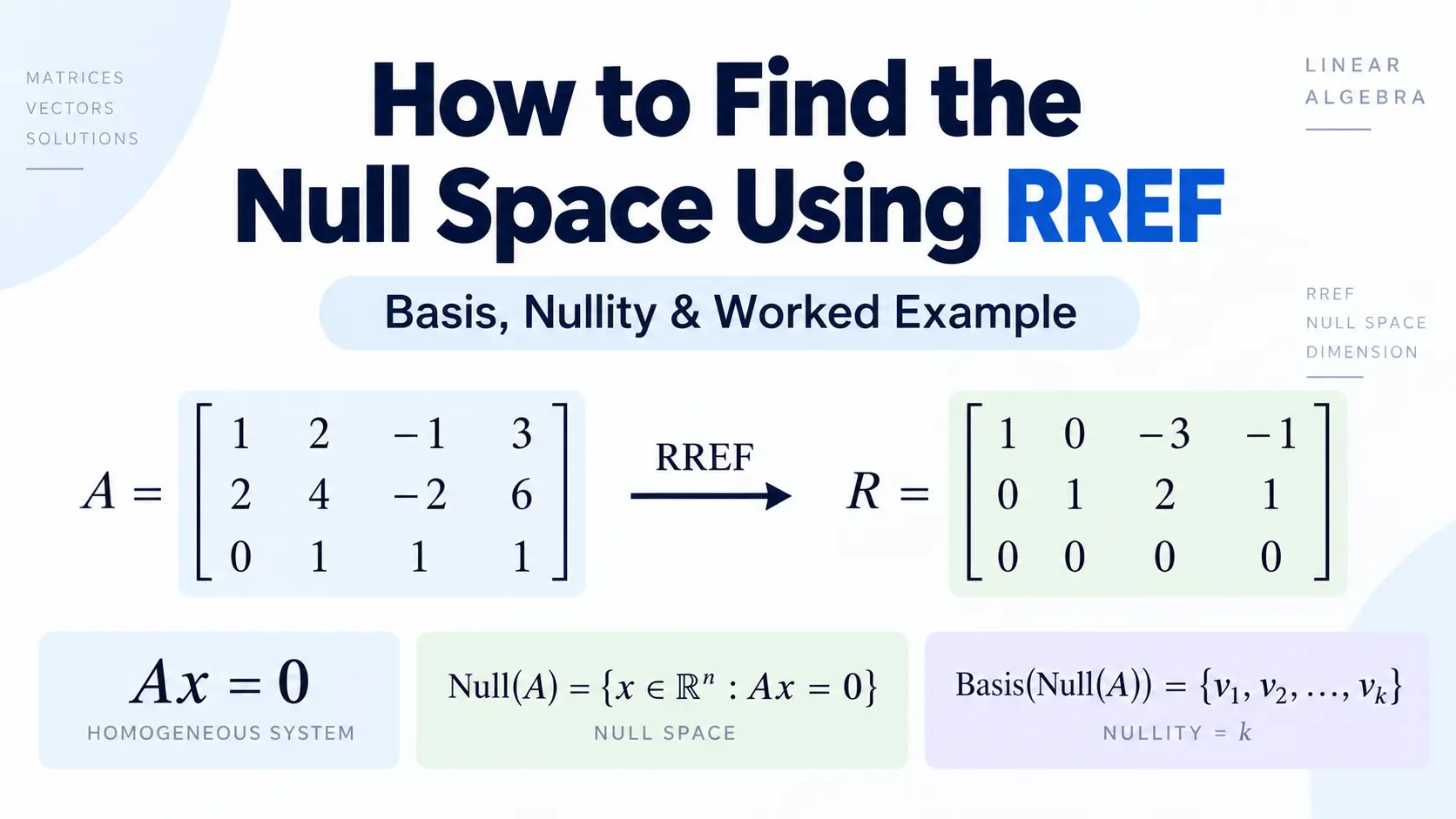
How to Find the Null Space of a Matrix Using RREF
To find the null space of a matrix A, solve the homogeneous system
Ax = 0.
Reduce A to RREF, identify the free variables, express the pivot variables in terms of them, and separate the resulting solution into vectors. Those vectors form a basis for the null space.
The null space, also called the kernel, is
Null(A) = {x : Ax = 0}.
Finding a Null-Space Basis from RREF
Consider
| 1 | 2 | -1 | 3 |
| 2 | 4 | 1 | 9 |
| 1 | 2 | 2 | 6 |
Using the RREF calculator, its reduced form is
| 1 | 2 | 0 | 4 |
| 0 | 0 | 1 | 1 |
| 0 | 0 | 0 | 0 |
Columns 1 and 3 contain pivots, so x1 and x3 are pivot variables. Columns 2 and 4 do not contain pivots, making x2 and x4 free variables.
Let
x2 = s, x4 = t.
Reading the equations from the RREF gives
x1 + 2x2 + 4x4 = 0
and
x3 + x4 = 0.
Therefore,
x1 = -2s – 4t, x3 = -t.
The complete solution is
| -2s – 4t |
| s |
| -t |
| t |
Separate the free parameters:
| -2 |
| 1 |
| 0 |
| 0 |
| -4 |
| 0 |
| -1 |
| 1 |
So a basis for the null space is
| -2 |
| 1 |
| 0 |
| 0 |
| -4 |
| 0 |
| -1 |
| 1 |
and
| -2 |
| 1 |
| 0 |
| 0 |
| -4 |
| 0 |
| -1 |
| 1 |
Nullity: Count the Free Variables
The nullity of a matrix is the dimension of its null space.
This matrix has two free variables, so
nullity(A) = 2.
There are four columns and two pivot columns, giving
rank(A) = 2.
The rank-nullity theorem provides a quick check:
rank(A) + nullity(A) = n
2 + 2 = 4.
Here, n is the number of columns—not the number of rows.
How to Check Your Null-Space Basis
A simple verification catches sign and transcription errors.
Multiply the original matrix A by each proposed basis vector. Every valid null-space vector must satisfy
Av = 0.
For this example,
| -2 |
| 1 |
| 0 |
| 0 |
| 0 |
| 0 |
| 0 |
| -4 |
| 0 |
| -1 |
| 1 |
| 0 |
| 0 |
| 0 |
Both vectors are therefore in Null(A).
What If There Are No Free Variables?
If every column of A contains a pivot, there are no free variables. Then
Null(A) = {0}.
This is called the trivial null space, and its nullity is 0.
The key distinction is simple: pivot variables are determined; free variables create the independent directions that form the null-space basis.
For the row reduction itself, use the RREF calculator and then apply the steps above. If you’re deciding whether RREF or ordinary Gaussian elimination is better for a matrix problem, see RREF vs Gaussian Elimination: Which to Use & When.